

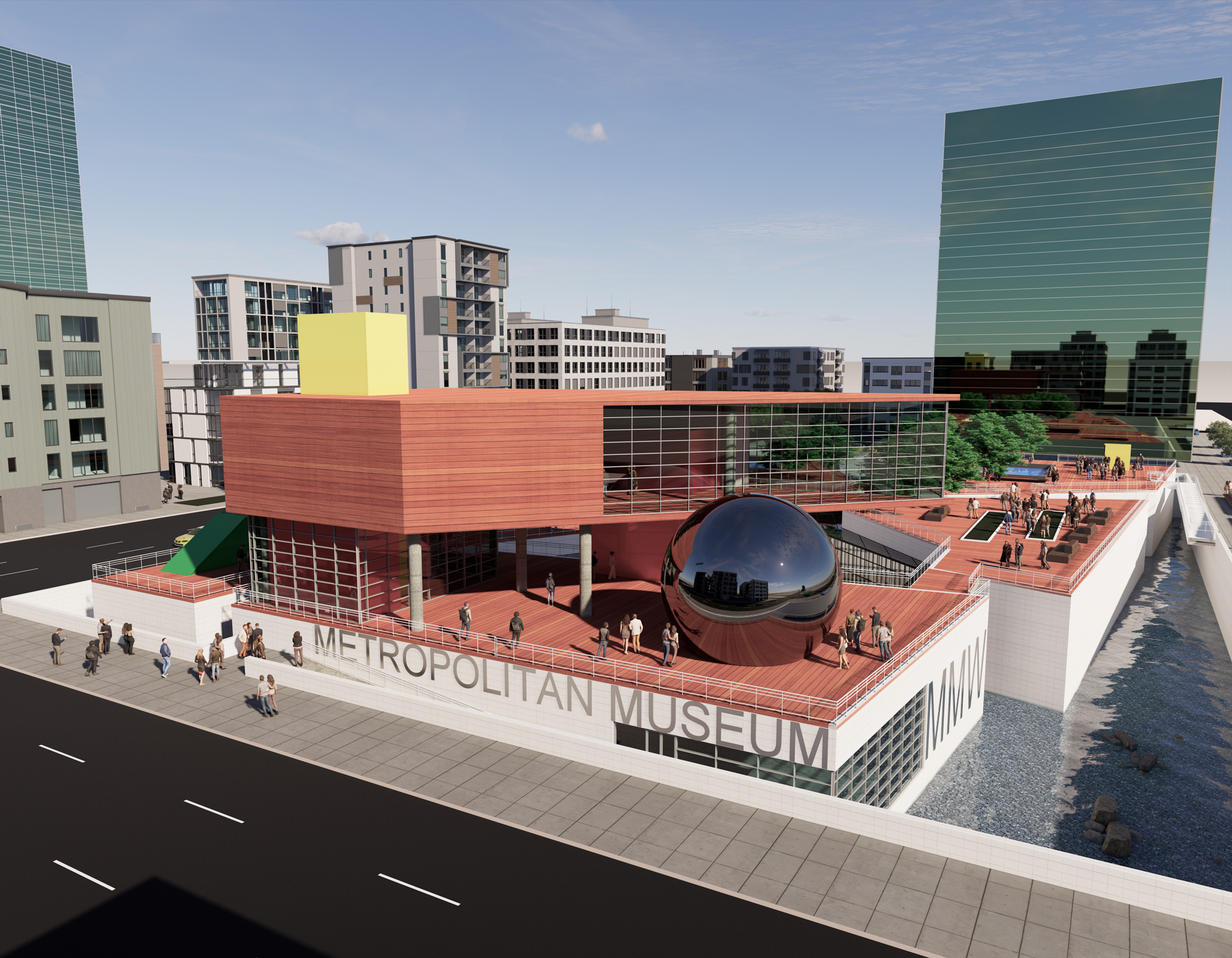
The museum is developed as a solid mass subjected to acts of subtraction and incision. The resulting fragments form distinct exhibit halls, while the intervening voids become connective tissue. These in-between spaces resist singular definition: they are circulation routes, gathering places, informal galleries, and thresholds where events and encounters unfold. In this way, absence becomes as programmatically charged as presence.
At the perimeter, deeper voids extend into the earth as gardens and reflecting pools. These sunken landscapes create a layered urban depth—visible from the street, accessible from select galleries, and suggestive of a continuity between the life of the city above and the contemplative interior world below.
The plaza above is conceived not as a flat expanse but as an archipelago of “islands,” linked by bridges and approached by ramps that weave into the surrounding sidewalks. Each island hosts a different public possibility—play, rest, performance, sculpture—so that the plaza becomes less a surface and more a field of encounters.
The project ultimately speculates on how institutional space might dissolve its boundaries, embedding itself into the city while offering back a new public ground. It asks whether the act of excavation—removing, carving, voiding—can generate not emptiness but an intensified form of urban life.